Dear Maintenance Men:
Dear Maintenance Men:
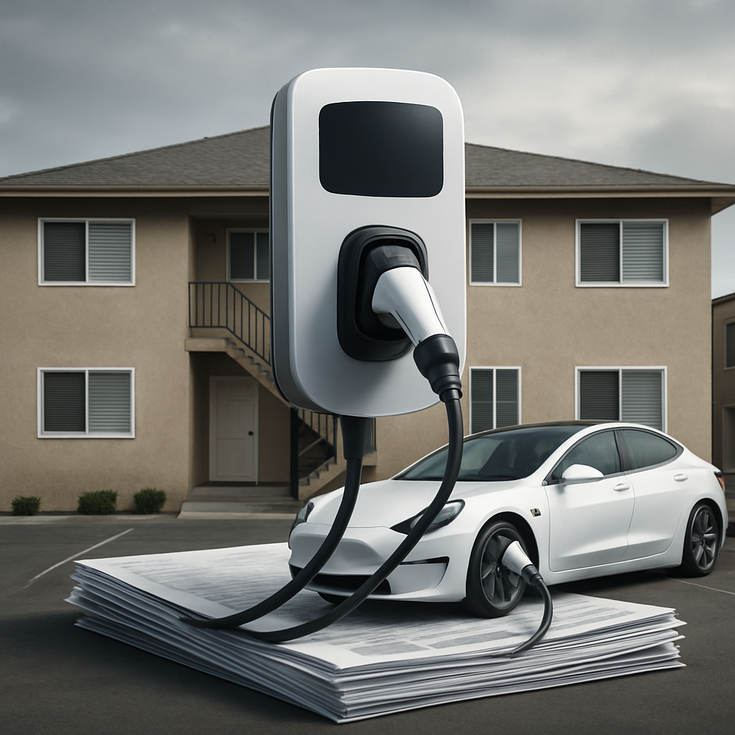
My tenant wants me to install EV chargers in our 4-Plex because he just bought a Tesla. He gave me many documents that said SCE will provide some financial and installation help under one scenario and all the financial and installation help under another. Our property is in a low to medium income area. I doubt Mr. Tesla owner will rent much longer from us without this upgrade. What do you suggest?
Ruth
Dear Ruth:
This is a common scenario in California and other states, and given your property is in a low-to-medium income (LMI) area, you are likely eligible for significant financial incentives that could turn this request into a “free” capital improvement that adds long-term value to your 4-plex.
Given the likelihood of the tenant eventually leaving, you should treat this as upgrading the property’s infrastructure, not just serving one tenant.
Here is a structured suggestion on how to approach this:
1. Leverage Incentives (The “Free Upgrade” Scenario)
Your tenant is likely referring to Southern California Edison (SCE) programs or statewide California Energy Commission (CEC) initiatives, which are heavily focused on LMI and disadvantaged communities.
- SCE Charge Ready Home Program: If the tenant is low-income, they might get 100% of the cost covered ($4,200) for a 240-volt circuit and charger installation.
- Multifamily EV Charger Assistance Program: Since you have 4 units, your property may qualify for 4+ port installation grants. In LMI areas, programs can cover up to 100% of installation and equipment costs.
- Federal Incentives (30C Tax Credit): As a business owner/landlord in an LMI census tract, you may be eligible for a tax credit for 30% of the installation costs.
2. Proposed Strategy: The “Yes, But” Approach
You should agree, but with strict controls to protect your property and ensure you own the infrastructure permanently.
- Use Certified Contractors: Require that only licensed, bonded, and insured electricians perform the work, with all necessary city permits and inspections.
- Infrastructure over Equipment: Rather than just letting him put in a cheap plug-in, have the electrician install a dedicated 240-volt circuit or a hardwired “Level 2” charger that remains at the property permanently.
- No Property Damage: The installation must not ruin the aesthetics of the building (conduit runs, etc.).
- Payment Setup: Ask the tenant to handle the installation initially through SCE’s programs to keep your upfront costs zero, but ensure the final inspection brings the, say, $10,000 project to a cost of $0-$1,000 to you.
3. Handling the “Tenant Will Leave” Risk
You are likely correct that the tenant will not stay forever.
- Value Addition: An EV charger is a desirable amenity. It will allow you to attract higher-quality tenants and charge higher rent for that specific unit when he leaves.
- Increase Rent/Charge for Usage: If you pay for the electricity, you can structure a fee system for the charger’s usage. If the charger is linked directly to the tenant’s electrical panel (since you have 4 units), you have no utility cost risk.
- No Removal Clause: Explicitly state in a written agreement that any electrical upgrades (240V circuits, hardwired chargers) stay with the property when the tenant leaves.
4. Summary Recommendation
- Do not pay 100% of the costs yourself.
- Do tell the tenant: “I will allow this, but I need to oversee the project to ensure it is done legally, safely, and permanently. I want to use the SCE Charge Ready program to make it free or almost free for both of us.”
- Confirm whether the area is an LMI or Disadvantaged Community (DAC) using the SCE Charge Ready website.
- Make sure you have a signed agreement that the infrastructure belongs to the 4-plex.
If the tenant is unwilling to work within a proper, permitted, and documented process that leaves the equipment for your benefit, deny the request and tell them to use public charging.
Dear Maintenance Men:
Our apartment building contains all two-bedroom two-bath units. One of our residents is complaining that the hot water in the shower turns cold after 5 or so minutes while the other shower will give hot water for as long as needed. What’s the problem?
Steve
Dear Steve:
Sounds like you have an anti-scald valve malfunctioning. An anti-scald valve prevents the user from getting burned or scalded by hot water when there is a drop in cold-water pressure, such as when a toilet is flushed. Some valves are built into the mixing valves, others are separate. Determine the valve brand and model and take that information to your local plumbing supplier. The supplier should be able to sell you any replacement parts necessary.
Dear Maintenance Men:
The weather is getting warmer and I have just finished rehabbing my building’s landscaping. When is the best time to have my automatic sprinklers scheduled to turn-on?
David
Dear David:
According to landscape experts, the best time to turn on the sprinklers is between 5:00 a.m. and 6:00 a.m. This allows the water to soak in and then allows the sun to dry out the landscape to avoid rot & disease. That being said … we personally like our sprinklers to activate between 2:30 & 5:00 AM. This time period is after the bars close and before the early birds leave for work. Avoiding resident interaction with working sprinklers lessens the chance of sprinkler heads being kicked or damaged. Also, most of the kids are still asleep and we all know how they love to run through your sprinklers, flowers, plants etc. Adjust your sprinklers to not spray across sidewalks or onto parked cars. It is also a good idea to install your timer in a locked location or very high on an exterior wall.
By Jerry L’Ecuyer & Frank Alvarez
If you need maintenance work or consultation for your building or project, please feel free to contact us. We are available throughout Southern California. For an appointment, please call Buffalo Maintenance, Inc. at 714 956-8371
Frank Alvarez is licensed contractor and the Operations Director and co-owner of Buffalo Maintenance, Inc. He has been involved with apartment maintenance & construction for over 30 years. Frankie is President of the Apartment Association of Orange County and a lecturer, educational instructor and Chair of the Education Committee of the AAOC. He is also Chairman of the Product Service Counsel. Frank can be reached at (714) 956-8371 Frankie@BuffaloMaintenance.com For more info please go to: www.BuffaloMaintenance.com
Jerry L’Ecuyer is a real estate broker. He is currently a Director Emeritus and Past President of the Apartment Association of Orange County and past Chairman of the association’s Education Committee. Jerry has been involved with apartments as a professional since 1988.