Dear Maintenance Men
By Jerry L’Ecuyer & Frank Alvarez
Dear Maintenance Men:
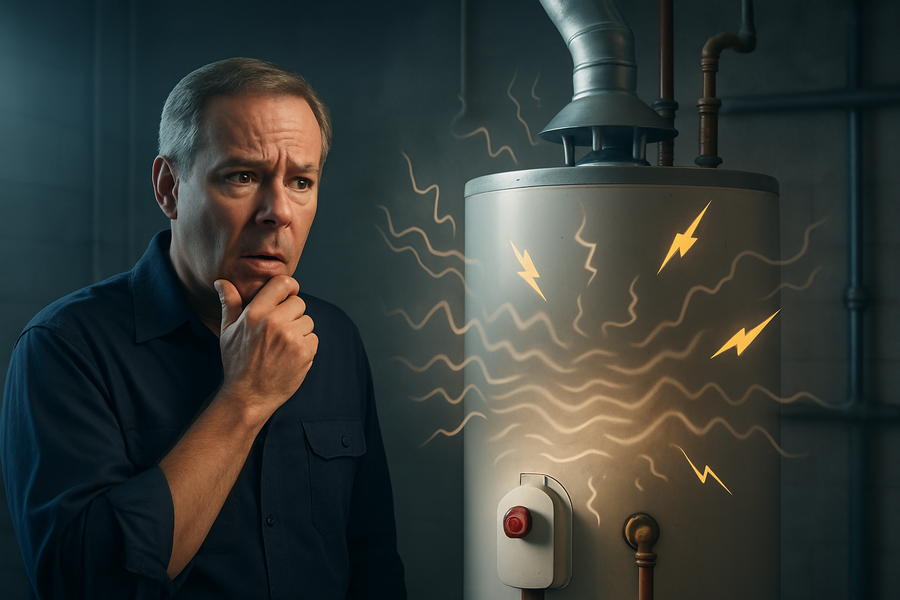
A resident is complaining that their water heater is knocking and making rumbling noises. They are worried it might explode. What is the problem, and how do I fix the rumbling issue?
First, the water heater will not explode; however, it could leak if this issue is left unchecked. Sediment collects at the bottom of the tank and traps water under layers of minerals such as calcium and lime. When the burner heats the water, the trapped water boils and bubbles up, causing the rumbling or knocking noise.
The solution is to flush the water heater of any accumulated sediment. (We will assume the tank in question is not a commercial unit with a cleanout port.) Keep in mind that a knocking water heater is also an indication that the water heater is nearing the end of its useful service life. A typical water heater’s service life is between 8 and 15 years. A commercial water heater with a cleanout port should be cleaned out yearly. A water softener will extend the life of any water heater.
Flushing procedure:
1. Turn off the gas or breaker to the heater.
2. Turn off the water supply above the tank.
3. Connect a hose to the drain valve at the bottom of the tank so the water can drain away from the heater. (Leave this valve closed for the moment.)
4. Open a hot-water valve in the unit, such as a shower valve or kitchen faucet.
5. Open the valve at the bottom of the tank to let the water drain through the hose. Caution: This water will be hot.
6. Allow the tank to drain completely.
7. Once the tank is empty, open and close the cold-water valve above the water heater. This will help flush any remaining sediment from the tank. Do this until the water runs clear out of the hose connected to the heater drain valve.
8. Close the drain valve and disconnect the hose from the bottom of the tank.
9. Open the cold-water valve above the water heater to fill the tank.
10. When water starts coming out of the shower or kitchen valves, the tank is full. Turn off the shower and kitchen valves. Leave the cold-water valve above the water heater open.
11. Relight the gas burner pilot and turn on the burner, or switch on the breaker for an electric heater.
This procedure should be part of your preventive maintenance routine and performed once a year. And don’t forget to check the anode rods.
________________
Dear Maintenance Men:
I want to install some low-voltage landscape lighting in the courtyard of my apartment building, and I need some advice. Should I go with a wired system or a solar-powered system?
Good question! Solar looks attractive, and it is very easy to install. You can’t get much more plug-and-play than sticking the light fixture in the ground and waiting for the sun to charge it.
Unfortunately, as great as solar seems, it does have some drawbacks. The light produced can be dim and may not last the whole night. The fixture must be in direct sunlight to recharge. If you want to use it simply to mark a path, it will do a good job, but if you want it to light up the path, it may not have enough power.
To light up a path or area, a wired low-voltage system is best. You will need to determine how many lights you will use and the wattage of the bulbs in each fixture. The wattage information will help you determine what size transformer and wire to use.
Light bulbs range in wattage from 4 watts to 50 watts. Do not exceed the bulb wattage as dictated by the transformer. As an example, a 300-watt transformer will support twelve 25-watt light fixtures or thirty 10-watt fixtures. Transformers are available in various capacities, including 88 watts, 100 watts, 200 watts, and 300 watts. There are also transformers with capacities as high as 600 watts and 900 watts. Typically, the 600- and 900-watt transformers allow the use of multiple cables from one transformer.
As far as what gauge wire to use, again, wattage will determine the wire size. For example, for a maximum of 150 watts, use 16-gauge wire; for 200 watts, use 14-gauge wire; and for 300 watts, use 12-gauge wire.
Keeping the above numbers in mind, using LED landscape lighting will dramatically change the amount of transformer power you will need. We highly recommend using LED fixtures in your landscape lighting designs.
________________
Dear Maintenance Men:
I own a small apartment building with an average amount of landscaping around the property. I have a garden service that comes each week. They cut, edge, and do what they’re supposed to do, I think, although they don’t spend a lot of time at the property. What should I expect from my landscapers or garden service?
We have a minimum list of items that should be completed at the property. If these items are skipped or ignored, we feel the property will suffer. On a weekly basis, we expect the garden service to provide the following:
1. Cut the grass.
2. Edge the grass.
3. Pull weeds from sidewalk cracks and around the building, including the alley.
4. Turn over the dirt in all the flowerbeds each week.
5. Pick up any trash around the property.
6. Sweep, blow, or hose down the walkways.
7. Turn on the sprinkler lines and check for clogged heads, broken lines, etc.
8. Check that the timer is set properly.
9. Cut, trim, and thin any shrubs or bushes.
10. Maintain communication with the owner about problems or improvements.
The above list takes time—a half-hour minimum at a small property. If your landscape gardener completes the list on a weekly basis, you could very well have the best-looking property on the block! That can mean higher rents…and if you add colorful flowers, perhaps even higher rents!
Finding a landscape gardener to consistently complete the above list is not easy. Ask your local apartment association for recommendations, or look in your neighborhood or city for a property with outstanding landscaping and ask who the gardener is. Have the gardener give you a quote according to your “list.”
Keep in mind that a landscape company or gardener who provides the above level of service will charge more than a “blow-and-go” gardener; however, your property will reflect that above-average service.
Water Trivia:
About 1,460 teratonnes (Tt) of water covers 71% of the Earth’s surface, mostly in oceans and other large bodies of water. The above number pales in comparison with the perceived amount of water a clogged toilet will allow to flow over the rim after flushing and before you can turn off the water valve under the toilet…
Bio:
If you need maintenance work or consultation for your building or project, please feel free to contact us. We are available throughout Southern California. For an appointment, please call Buffalo Maintenance, Inc. at (714) 956-8371.
Frank Alvarez is a licensed contractor and the Operations Director and co-owner of Buffalo Maintenance, Inc. He has been involved with apartment maintenance and construction for over 30 years. Frankie is President of the Apartment Association of Orange County and a lecturer, educational instructor, and Chair of the Education Committee of the AAOC. Frank can be reached at (714) 956-8371 or Frankie@BuffaloMaintenance.com. For more information, please visit www.BuffaloMaintenance.com.
Jerry L’Ecuyer is a real estate broker. He is currently a Director Emeritus and Past President of the Apartment Association of Orange County and past Chairman of the association’s Education Committee. Jerry has been involved with apartments as a professional since 1988.