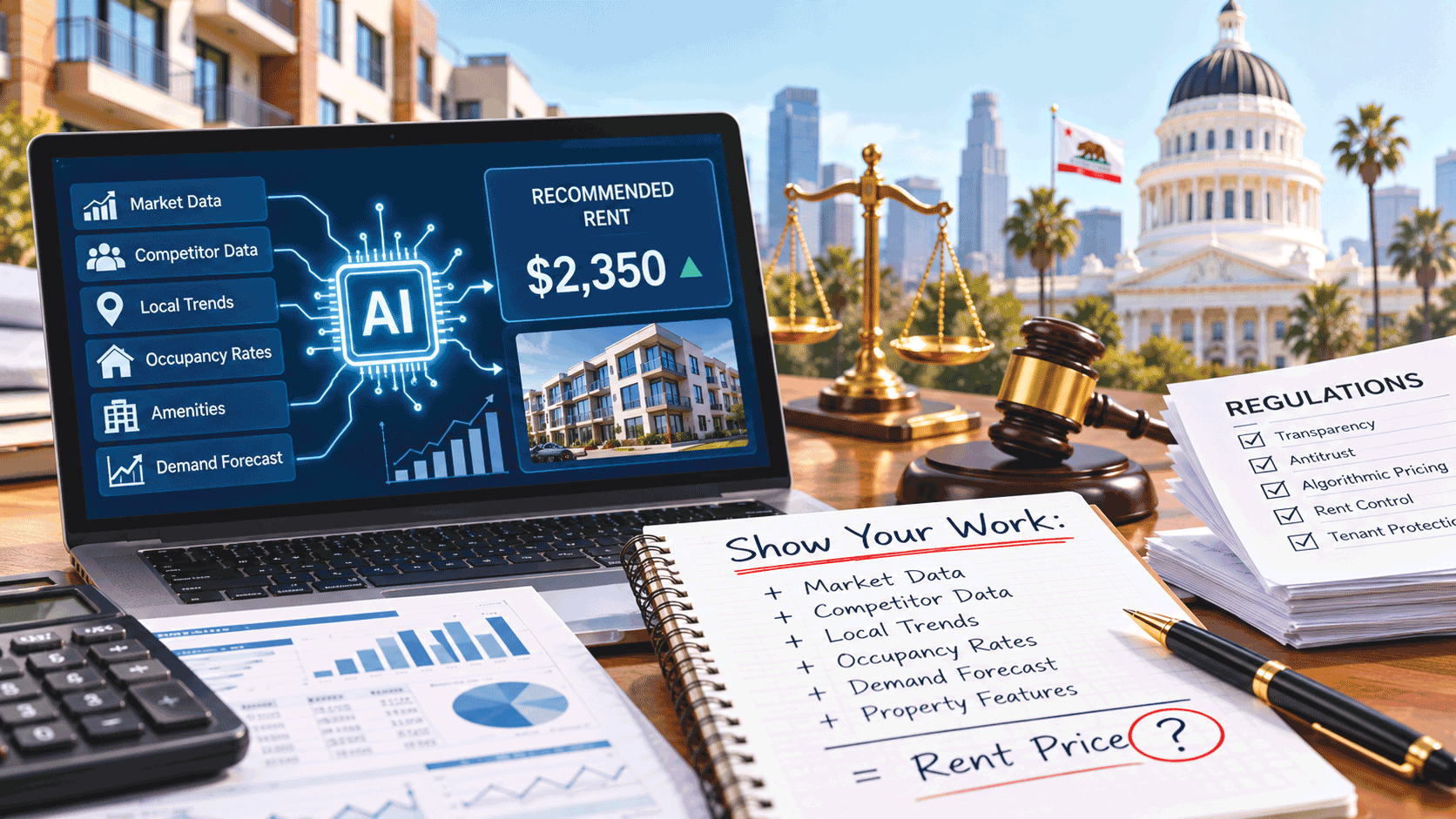
Show Your Work: The Policy Response to Algorithmic Rent-Setting
By: Danielle M. Leidner-Peretz, Founder of DLP Government Relations LLC
Housing policy has long been synonymous with a litany of rent regulations. Now lawmakers are not only asking how much you’re raising the rent but also how you arrived at the rate in the first place. It’s reminiscent of your math teacher asking to see the work behind your answer. Increasingly, policymakers are scrutinizing the use of algorithmic rent-setting technologies, and the challenge is understanding a policy landscape that is still taking shape.
In an era of artificial intelligence and ever-expanding innovation, price-setting tools are being used by multiple industries to analyze and inform business decisions. Their use by the rental housing industry has drawn heightened scrutiny, ongoing litigation and legislative action in multiple states and localities. Much of the concern stems from lawmakers’ view that these tools facilitate price fixing and artificially inflate rents, exacerbating housing affordability challenges. The issues also extend beyond housing policy into broader antitrust questions about competition, coordination and technology’s role in pricing decisions.
In simplest terms, algorithmic pricing software is a revenue management tool that analyzes market data and trends to support pricing decisions. How does software intended to improve efficiency and support informed decision-making run contrary to public policy? While jurisdictions vary in their approach, laws draw the line between permissible and prohibited uses of algorithmic pricing tools based on factors such as the type of data used, whether the software serves multiple users and the recommendations generated from that data.
California was the first state to enact statewide legislation, amending its antitrust statute, the Cartwright Act, to address algorithmic pricing across industries when certain conditions are met. The law establishes two prohibitions: using or distributing a “common pricing algorithm” as part of an unlawful restraint of trade, and using or distributing the software where a person coerces another person to set or adopt a price or commercial term recommended by the algorithm for the same or similar products or services in California. The definition of “common pricing algorithm” provides the essential elements: the software is used by two or more persons and uses competitor data to recommend or otherwise influence a price or commercial term.
While California’s law establishes specific boundaries, it also presents practical challenges. Competitor data is undefined and there is no clear threshold for when an algorithmic recommendation crosses the line into coercion. From the end-user perspective, a platform’s data practices and operations may not be readily apparent, yet could potentially expose users to violations.
New York, New Jersey and Connecticut are among the states that have enacted similar laws restricting algorithmic pricing tools within the context of the rental housing industry. New Jersey’s and Connecticut’s statutes define the data at issue. Connecticut’s definition limits its scope to data not available to the general public, while New Jersey goes further, stating that the data is not available to the public at no cost. As states and localities have moved toward greater regulation, Colorado stands out for vetoing similar legislation. Governor Polis argued that collusion and restraints on trade are already prohibited under the existing antitrust law. He also warned against removing tools that serve a legitimate purpose and that “reducing market friction through legitimate means that do not entail collusion is good for both renters and landlords.”
California’s local dynamics are equally active. Notably, local action preceded the broader statewide initiative. In 2024, San Francisco adopted an ordinance banning the sale and use of any algorithmic device that “sets, recommends, or advises on rents or occupancy levels that may be achieved for residential dwelling units in San Francisco.” The City’s actions were prompted by the perceived threat that algorithmic devices facilitate indirect coordination through the sharing of non-public, competitively sensitive data, which is then used to perform calculations to set or recommend rent and occupancy levels, contributing to inflated rental rates and unfair rent increases. To what extent do these tools actually contribute to higher rents? This rationale is shared by other localities, including Berkeley, Santa Ana, San Diego, Santa Monica and West Hollywood, which have enacted similar ordinances.
Local ordinances generally prohibit both the sale and use of covered algorithmic devices. The line between permitted and prohibited activity often hinges on how an “algorithmic device” is defined. Some ordinances specify that the data must come from two or more competing landlords, while others require recommendations to involve coordination between a landlord and one or more competitors, including through a third-party vendor. Covered data is often limited to non-public competitor data, generally defined as information not available to the general public, although some ordinances exclude data more than 90 days old.
Will Los Angeles follow the same path taken by other localities or go in a different direction? In 2025, the City Council sought to understand the extent to which ownership and management entities were using algorithm-based software to establish rents and whether the City could ban such use. The matter remained stagnant until recently, when a new motion was advanced by the Housing Committee this October. The motion directs the City to examine potential approaches, including a registration and disclosure program, tenant notification requirements, registration fees and enforcement mechanisms. Part of the review includes assessing the City’s legal authority to restrict or prohibit the use of algorithmic rent-setting technologies that rely on nonpublic competitor information and an evaluation of regulatory practices in other jurisdictions. During the Committee discussion on the motion, questions raised went to the heart of the issue: What public policy problem is the City seeking to regulate? Is it the technology itself, reliance on the technology or disclosure of its use?
Which brings us back to the question: How does software intended to improve efficiency and support informed decision-making run contrary to public policy? The proliferation of state and local laws reflects growing concern over how these tools are used in rental housing. Technology isn’t inherently bad. The challenge for policymakers is distinguishing between tools that facilitate anticompetitive conduct and those that serve legitimate business optimization and to advance legislation that appropriately addresses the former without constraining the latter. Will these restrictions narrowly target concerns or sacrifice the legitimate value of the technology in the process? And more directly to the point, do these policies meaningfully address the housing affordability concerns raised or simply serve as a deterrent to the use of these tools by housing providers?
This article is intended for informational purposes only and does not constitute legal advice. Readers should consult with qualified counsel regarding their specific circumstances.
Danielle M. Leidner-Peretz is the Founder of DLP Government Relations LLC, specializing in expert advocacy and ethical insight. She offers strategic counsel across a range of policy issues, delivering tailored, results-driven solutions for navigating complex government and regulatory challenges. She previously served as the Director of Government Relations for the Apartment Association of Greater Los Angeles. For more information, go to www.dlpgovernmentrelations.com.