Would You Like to Keep Proposition 13? Sign Here!
“Millions of California property owners have it in their power to get this measure on the ballot just by spreading the word: Go to SaveProp13.com. Print, sign, mail, Save Proposition 13.”
By Susan Shelley, Howard Jarvis Taxpayers Association
The Howard Jarvis Taxpayers Association is taking action to protect property owners and all California taxpayers with a new initiative that closes court-created loopholes in Proposition 13.
For nearly 50 years, taxpayers have been in a war with state and local government over whether it will or will not be easier to raise taxes. Proposition 13, approved by a landslide margin in 1978, made it significantly harder to raise taxes. It changed the state constitution to place a 2% limit on annual increases in property tax assessments for as long as the property is under the same ownership, and it cut the tax rate on property to a flat 1%.
For comparison, before Proposition 13, property was reassessed to current market value every year, and the statewide average tax rate was 2.67%. Property owners who are confused about Proposition 13 and think it’s not helping them should check out the Howard Jarvis Taxpayers Association’s carnival game-style calculator at GuessingGame.org. Enter the current market value of your property and press the button. It will tell you what you’d be paying in annual property taxes if Proposition 13 had never passed.
Don’t Do It If You’re Driving, or If You Have a Pacemaker.
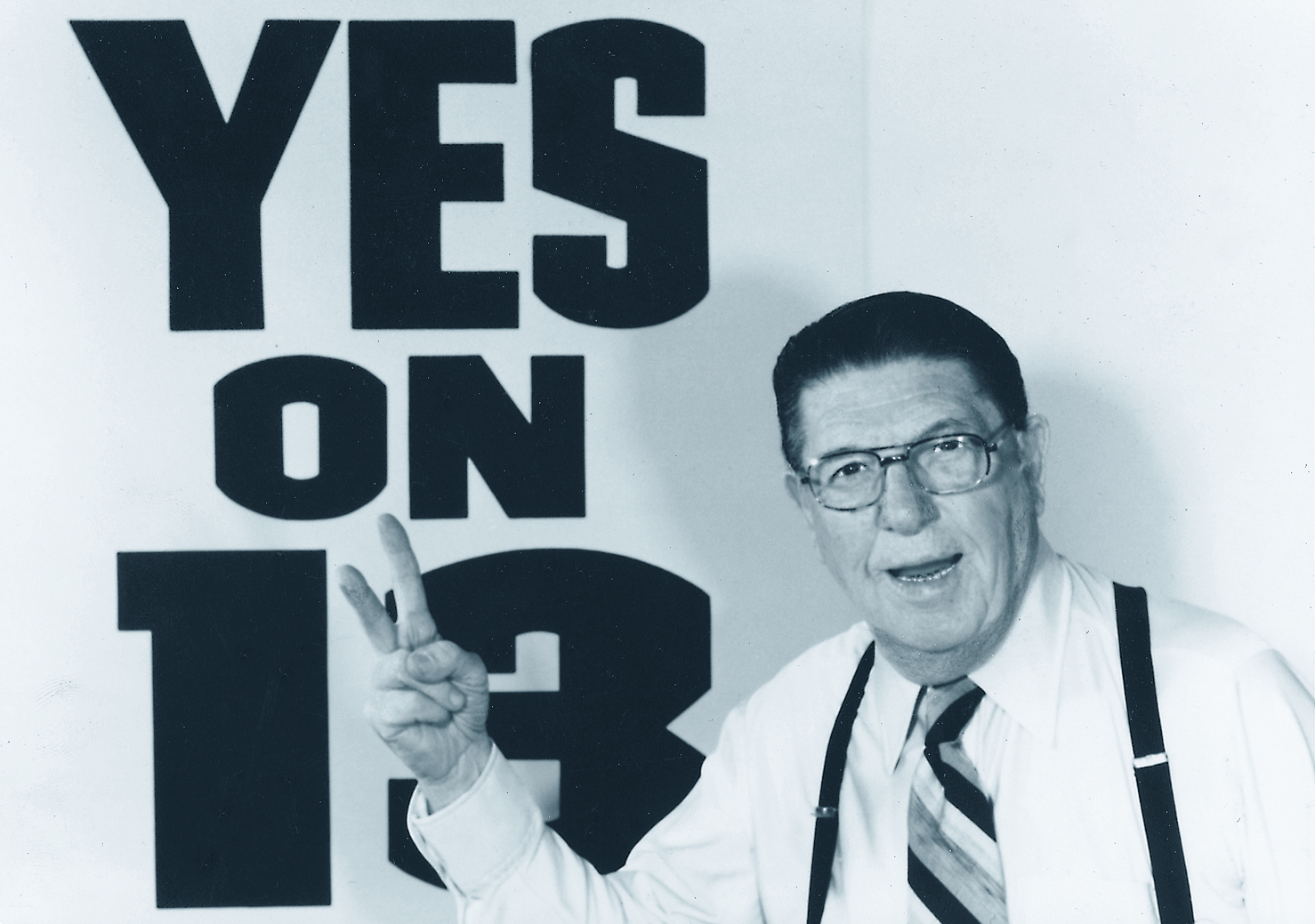
Howard Jarvis was a longtime critic of excessive property taxes, and, beginning in 1973, the executive director of the Apartment Association of Greater Los Angeles. He anticipated that politicians would react to his tax-cutting initiative by scheming to raise other taxes to get the same money from the same people. So, he added a few things to Proposition 13 to stop that from happening.
Proposition 13 required a two-thirds vote in each house of the legislature to raise state taxes. It required all local special taxes to go on the ballot and get a two-thirds vote to pass. Proposition 13 banned new ad valorem (based on value) taxes, and it specifically prohibited new real estate transfer taxes above the existing 0.11% documentary transfer tax that was already in the Revenue and Taxation Code.
And so, the war began. Politicians, assisted by the courts, found ways to define “special” taxes as different from “general taxes,” holding that general taxes could pass with a simple majority instead of two-thirds. A new species of taxation called “parcel taxes” was invented to tax property without basing the tax on value. Politicians tried renaming taxes as “fees” or “assessments,” eventually leading to more initiatives from taxpayers to stop the costly gamesmanship.
The Upland Exception
The latest battle stems from state appellate courts interpreting ambiguous language in the California Supreme Court’s 2017 decision in California Cannabis Coalition v. City of Upland. In this interpretation, special taxes no longer require a two-thirds vote to pass, as long as they’re put on the ballot by a citizens’ initiative. According to the courts, if a tax increase is placed on the ballot by a citizens’ initiative, the state constitution, including Proposition 13, may not apply at all.
This is how property owners in the city of Los Angeles, including the owners of multifamily rental housing, were saddled with Measure ULA. The so-called “Mansion Tax” is effectively a 4% to 5.5% sales tax on real estate valued above $5 million. It is levied without regard to profit or loss.
Although Proposition 13 completely prohibited new transfer taxes, several court decisions in the 1990s carved out a loophole in that prohibition. Charter cities, those that have their own local constitution, were allowed to levy transfer taxes for general purposes. Transfer taxes for “special” purposes were still prohibited.
Measure ULA is a transfer tax for a special purpose – homelessness – so according to the constitution and case law, it should have been invalidated. However, a court in California ruled that the Upland decision means the constitution doesn’t apply to Measure ULA. Why? Because it was a “citizens’ initiative.”
Enough is Enough
The Howard Jarvis Taxpayers Association (HJTA) has had enough of this. HJTA has filed a new initiative, the Local Taxpayer Protection Act to Save Proposition 13. It does two things:
- It restores the two-thirds vote requirement for all local special taxes, even “citizens’ initiative” tax increases (typically written by special interests to direct the money to themselves).
- It bans and repeals all real estate transfer taxes higher than 0.11%, including Measure ULA.
This constitutional amendment will close court-created loopholes in Proposition 13 and protect property owners from efforts by politicians to “take back” the Proposition 13 tax reduction that voters overwhelmingly approved in 1978 and still support strongly today.
The initiative will appear on the November 2026 ballot if HJTA collects about 875,000 valid signatures of registered California voters before February 25. HJTA is innovating to enable voters to download and print the official petition at home, on one sheet of ordinary letter-sized paper, on any printer. Millions of California property owners have it in their power to get this measure on the ballot just by spreading the word: Go to SaveProp13.com. Print, sign, mail, Save Proposition 13.
Susan Shelley is a columnist for the Southern California News Group and VP of Communications for the Howard Jarvis Taxpayers Association. Write to her at Susan@hjta.org and follow her on X at @Susan_Shelley.